Best Sleep Trackers and Apps of 2026
The Oura Ring 5 is the best sleep tracker of 2026. See why it beat the Apple Watch Series 12 and Garmin Index Sleep Monitor, plus three sleep picks to know.
The verdict
The Oura Ring 5 wins because it packs sleep staging, temperature trends and a new 30-day breathing view into the smallest ring Oura has made, with published lab comparisons behind its sleep stages. The Apple Watch Series 12 is the finalist for people who want an FDA-cleared sleep apnea check on the wrist, and the Garmin Index Sleep Monitor is the finalist for anyone who wants a dedicated night-only band.
| Award | Product | Best for |
|---|---|---|
| Winner | Oura Ring 5 | Sleepers who want detailed nights from a tiny ring |
| Finalist | Apple Watch Series 12 | iPhone owners who want an FDA-cleared apnea check |
| Finalist | Index Sleep Monitor Garmin | People who want a night-only band, no watch |
| Commended | Galaxy Watch9 Samsung | Android users who want bedtime timing advice |
| Commended | Sleep Cycle Sleep Cycle AB | Tracking snoring and waking gently without a wearable |
| Commended | RISE Rise Science | Planning your day around sleep debt and energy |
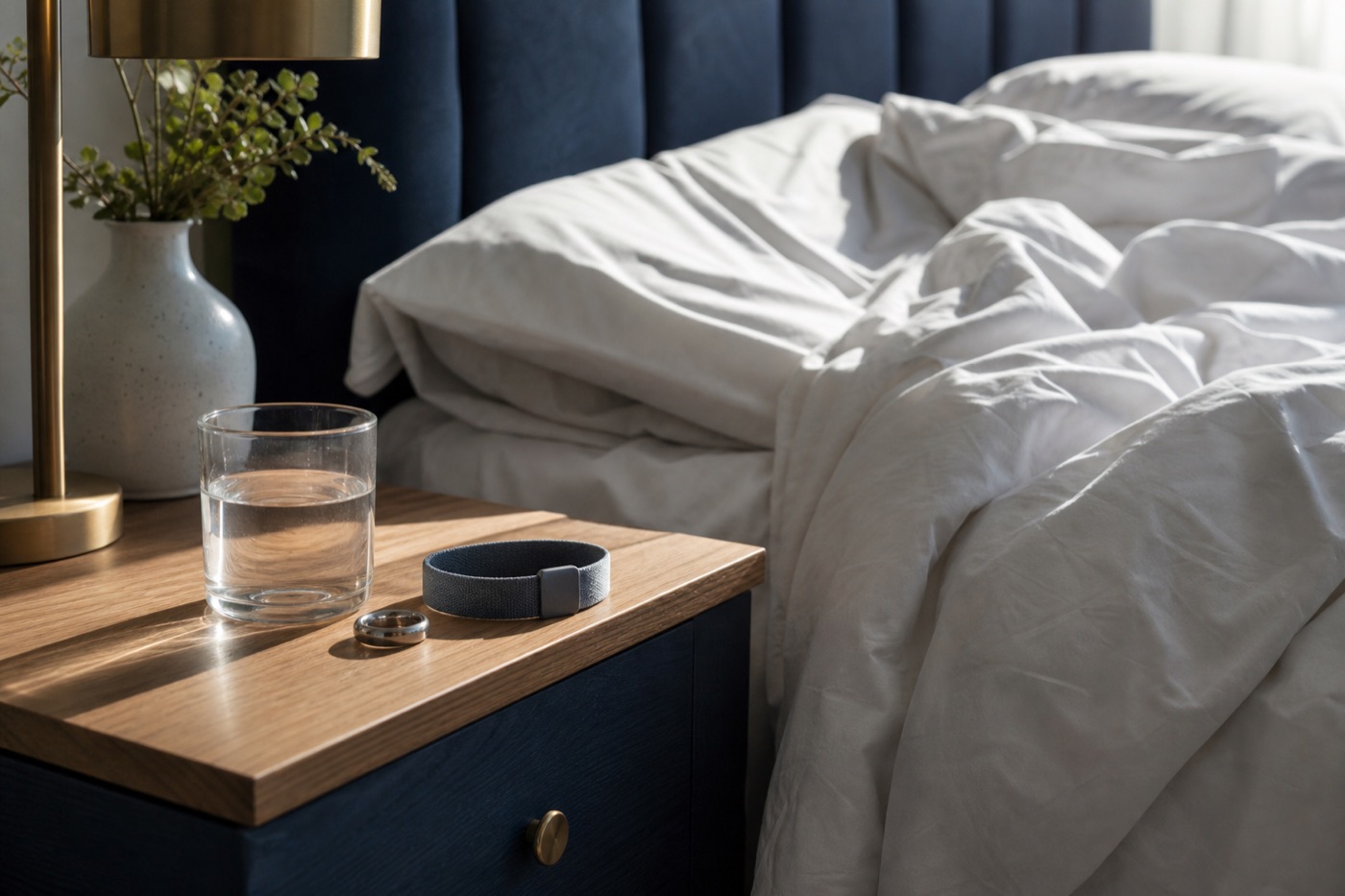
The best sleep tracker of 2026 is the Oura Ring 5, a much smaller ring that Oura began shipping on June 4 and that keeps sleep at the center of its app. The Apple Watch Series 12 and the Garmin Index Sleep Monitor are this year’s finalists, and three more products, one watch and two phone apps, earn a commendation.
What decided the sleep category
Sleep is the hardest thing a consumer gadget tries to measure. The reference method, polysomnography, wires a sleeper’s scalp, face and chest in a lab; rings, watches and bands infer the same stages from pulse, motion and skin temperature. So published evidence carried real weight here: lab comparisons, peer-reviewed studies and FDA clearances counted for more than marketing language about “accuracy.”
The second filter was whether people will actually keep the device on all night. Battery life, comfort and how much the hardware intrudes on a bed partner all fall under everyday usefulness. Access mattered too, since several products here work with only one phone platform or keep their best insights behind a membership. The full weighting of the five factors is laid out on our criteria page.
Winner: Oura Ring 5
Oura’s 2026 ring is, in the company’s own words, 40% smaller than the Ring 4. The Member Care page lists it at 6.09 mm wide and 2.28 mm thick, down from 7.9 mm and roughly 2.88 mm on the previous model. For a sleep tracker, size is not a cosmetic detail: a ring that disappears on the finger is a ring that stays on through the night, every night.
On paper the hardware covers everything a modern sleep tracker reads. Oura lists red and infrared LEDs for blood oxygen, green and infrared LEDs that alternate to read heart rate, heart rate variability and respiration rate around the clock, a digital temperature sensor and an accelerometer. The company rates battery life at six to nine days depending on ring size and use, against five to eight days for the Ring 4, which means a charge roughly once a week rather than every morning.
What pushed the Ring 5 ahead this year was Health Radar, the software layer Oura launched alongside it. One of its two launch features, Nighttime Breathing, gives members a rolling 30-day view of breathing patterns and disturbances during sleep. Oura is careful about what this is and is not: its Health Radar page says the features are for general wellness only, and that the ring is not a medical device. Read that as a prompt to start a conversation with a clinician, not as an apnea test.
The evidence case is stronger than most rivals can show. A 2024 study in Sensors put 35 healthy adults through one night in a sleep lab wearing an Oura Gen3 ring, an Apple Watch Series 8 and a Fitbit Sense 2. The researchers found the Oura ring was not statistically different from polysomnography for wake, light, deep or REM sleep, while the Fitbit overestimated light sleep and the Apple Watch underestimated deep sleep by 43 minutes on average. Two cautions apply: the work was funded by Oura, and it tested the Gen3 rather than the Ring 5.
The Ring 5 works with both iPhone and Android phones, and Oura states that it will never sell or rent members’ health data, including to the government. Those two points lifted it on access and privacy.
Who should skip it: anyone who does not want a recurring membership, since Oura says its membership is what unlocks personalized insights and new features. The size range has also narrowed to 6 through 13, and the ring now stores about three days of data between syncs instead of seven.
Finalist: Apple Watch Series 12
Apple’s newest watch brings an FDA-cleared screening feature to the category. Its sleep apnea notifications, which also run on Series 9 and later, Ultra 2 and later and SE 3, were cleared by the FDA through a 510(k) in September 2024. Apple says the feature looks for signs of moderate to severe sleep apnea in adults 18 and older who have not been diagnosed.
The Series 12 carries the nightly sleep score Apple introduced in 2025 and adds a new readiness experience exclusive to this model and the Ultra 4. Each morning it produces a score from 0 to 10, built from recent activity, vitals and sleep, with a plain recommendation ranging from “Recover” to “Go For It.” Apple also says Health data is encrypted on the device, and end-to-end in iCloud when two-factor authentication is on.
The trade-off is the battery. Apple rates the Series 12 at up to 24 hours of normal use, or 38 in Low Power Mode, so sleep tracking means finding a charging window every day. It also requires an iPhone 11 or later on iOS 27. Android owners and people who hate wearing a watch to bed should look elsewhere.
Finalist: Garmin Index Sleep Monitor
Garmin built this band for one job. It straps around the upper arm, has no screen and runs for up to seven nights with continuous Pulse Ox tracking, according to Garmin’s announcement. Overnight it records sleep stages, HRV status, breathing variations, respiration and skin temperature, then delivers a sleep score from 0 to 100 in the Garmin Connect app each morning.
Two touches make it practical. A smart wake alarm vibrates during lighter sleep in a window before your set time (the owner’s manual puts that window at 30 minutes), and the fabric band can go in the washing machine once the module is removed. Garmin also says all existing Garmin Connect features stay free, with its Connect+ plan optional.
It lost ground to the winner on published validation, since Garmin’s announcement cites no lab comparison for this band. It is also a night-only device; Garmin’s own suggestion for a day-and-night picture is to wear a compatible Garmin watch while awake.
Commended: Samsung Galaxy Watch9
The Galaxy Watch9, announced in July, is the strongest sleep watch on paper for Android owners. Samsung’s US page describes its sleep apnea feature as regulated by the FDA as a medical device, built on the De Novo authorization Samsung earned in 2024; it needs two nights of data within 10 days and is limited to adults 22 and older. Bedtime Guidance studies three nights of sleep to suggest a bedtime window. Skip it if you use an iPhone: Samsung lists Android 13 or later for these features.
Commended: Sleep Cycle
For people who will not wear anything to bed, Sleep Cycle is the simplest route. It needs no wearable, captures noises like snoring and sleep talking so you can follow trends, and its smart alarm aims to wake you in your lightest phase within a 30-minute window. It is on both the App Store and Google Play. Working from the nightstand, it gives a narrower picture of the night than a ring or watch, but it asks nothing of your body.
Commended: RISE
RISE takes a different approach: instead of grading last night, it tracks sleep debt and predicts an energy schedule for the day ahead, including when grogginess should lift and when to start winding down. The company says it can pull historical data from your phone on day one and works with Apple Health, Oura and Fitbit, so it pairs well with any tracker above. It does not replace one.
Side-by-side
| Product | Where it sits | Battery, per maker | FDA-regulated sleep feature | Phones |
|---|---|---|---|---|
| Oura Ring 5 | Finger | 6–9 days | None; Oura says it is not a medical device | iPhone and Android |
| Apple Watch Series 12 | Wrist | Up to 24 hours (38 in Low Power Mode) | Sleep apnea notifications, 510(k) cleared 2024 | iPhone 11 or later |
| Garmin Index Sleep Monitor | Upper arm | Up to 7 nights | None claimed | Garmin Connect app |
| Samsung Galaxy Watch9 | Wrist | 390 mAh cell (40 mm model) | Sleep apnea feature, De Novo authorized 2024 | Android 13 or later |
| Sleep Cycle | Phone by the bed | Phone | None claimed | iPhone and Android |
| RISE | Phone | Phone | None claimed | iPhone and Android |
Matching the tracker to the sleeper
- You want the fullest picture with the least on your body: Oura Ring 5.
- You already own an iPhone and worry about apnea: Apple Watch Series 12, with the understanding that it charges daily.
- You hate wearing anything on your wrist at night: Garmin Index Sleep Monitor.
- You carry a recent Samsung or other Android phone: Galaxy Watch9.
- You share a bed and mostly want to know who snores: Sleep Cycle.
- You care more about tomorrow’s energy than last night’s chart: RISE, layered on top of any tracker.
Where this leaves your nightstand
The 2026 field split into clear lanes: rings for unobtrusive detail, watches for regulated screening, and bands or apps for people who want sleep data without a daily-wear device. Oura earned the top prize because it was the only product that combined a form factor people forget they are wearing with published sleep-stage evidence and a new breathing view. If you are shopping for the coming year instead, the 2027 sleep tracker picks weigh this year’s launches differently, and anyone curious about rings as a broader category can compare them on our smart ring prize page.
2026 badges in this category
Winners and finalists may show their badge for free. It must link back to this page and not be altered. Badge rules.
Oura Ring 5
Winner, Sleep Trackers and Apps 2026
Embed code
<a href="https://innovationprizes.org/2026/best-sleep-trackers/"><img src="https://innovationprizes.org/badges/2026-best-sleep-trackers-winner.svg" alt="Innovation Prizes 2026 Winner: Sleep Trackers and Apps" width="160" height="160"></a>
Apple Watch Series 12
Finalist, Sleep Trackers and Apps 2026
Embed code
<a href="https://innovationprizes.org/2026/best-sleep-trackers/"><img src="https://innovationprizes.org/badges/2026-best-sleep-trackers-finalist.svg" alt="Innovation Prizes 2026 Finalist: Sleep Trackers and Apps" width="160" height="160"></a>
Index Sleep Monitor
Finalist, Sleep Trackers and Apps 2026
Embed code
<a href="https://innovationprizes.org/2026/best-sleep-trackers/"><img src="https://innovationprizes.org/badges/2026-best-sleep-trackers-finalist.svg" alt="Innovation Prizes 2026 Finalist: Sleep Trackers and Apps" width="160" height="160"></a>
Questions people ask
Can a ring really tell deep sleep from REM sleep?
A ring guesses at stages from pulse, heart rate variability, motion and skin temperature; it never reads brain waves the way a sleep lab does. The best published result so far comes from an Oura-funded lab study of the older Gen3 ring, so treat stage charts as good estimates rather than measurements.
Do I need a sleep tracker to find out if I have sleep apnea?
No. Apple's and Samsung's FDA-regulated features can only flag signs that are worth raising with a clinician, and a missing alert does not rule the condition out. If you snore loudly, wake up gasping or feel exhausted during the day, ask a doctor about a proper sleep study.
Is a phone app on the mattress as good as a wearable?
An app like Sleep Cycle works from your nightstand without anything on your body, which makes it good at catching snoring and timing an alarm. A ring, watch or band adds body signals such as heart rate and skin temperature, so it gives a fuller picture of the night.
Sources
Prize pages are written and reviewed by the Innovation Prizes editors from what each maker publishes, FDA records and published research. Nobody pays to enter or to win. About the prizes.