Best Blood Pressure Monitors, Watches and Apps for 2027
For 2027, the Omron 10 Series cuff is our top blood pressure pick. Cuffless wearables multiplied in 2026, but most are wellness estimates that lean on a cuff.
The verdict
The Omron 10 Series keeps the prize for 2027 because the cuffless products that arrived in 2026 still need a cuff to calibrate them or confirm what they flag, and this one adds an FDA-authorized AFib screen to each reading. The Apple Watch Series 12 is a finalist as the lone FDA-cleared hypertension notification on a watch, and Hilo Core is a finalist for the most frequent wearable estimates, sold as a wellness product.
| Award | Product | Best for |
|---|---|---|
| Winner | 10 Series Upper Arm Blood Pressure Monitor (BP7465) Omron Healthcare | A validated home baseline for every other device |
| Finalist | Apple Watch Series 12 | Undiagnosed adults who want a cleared background alert |
| Finalist | Hilo Core Hilo (Aktiia) | Seeing day and night blood pressure patterns between cuffs |
| Commended | BPM Vision Withings | Families sharing one cuff with guided measurements |
| Commended | Oura Ring 5 | Ring owners who want overnight blood pressure signals |
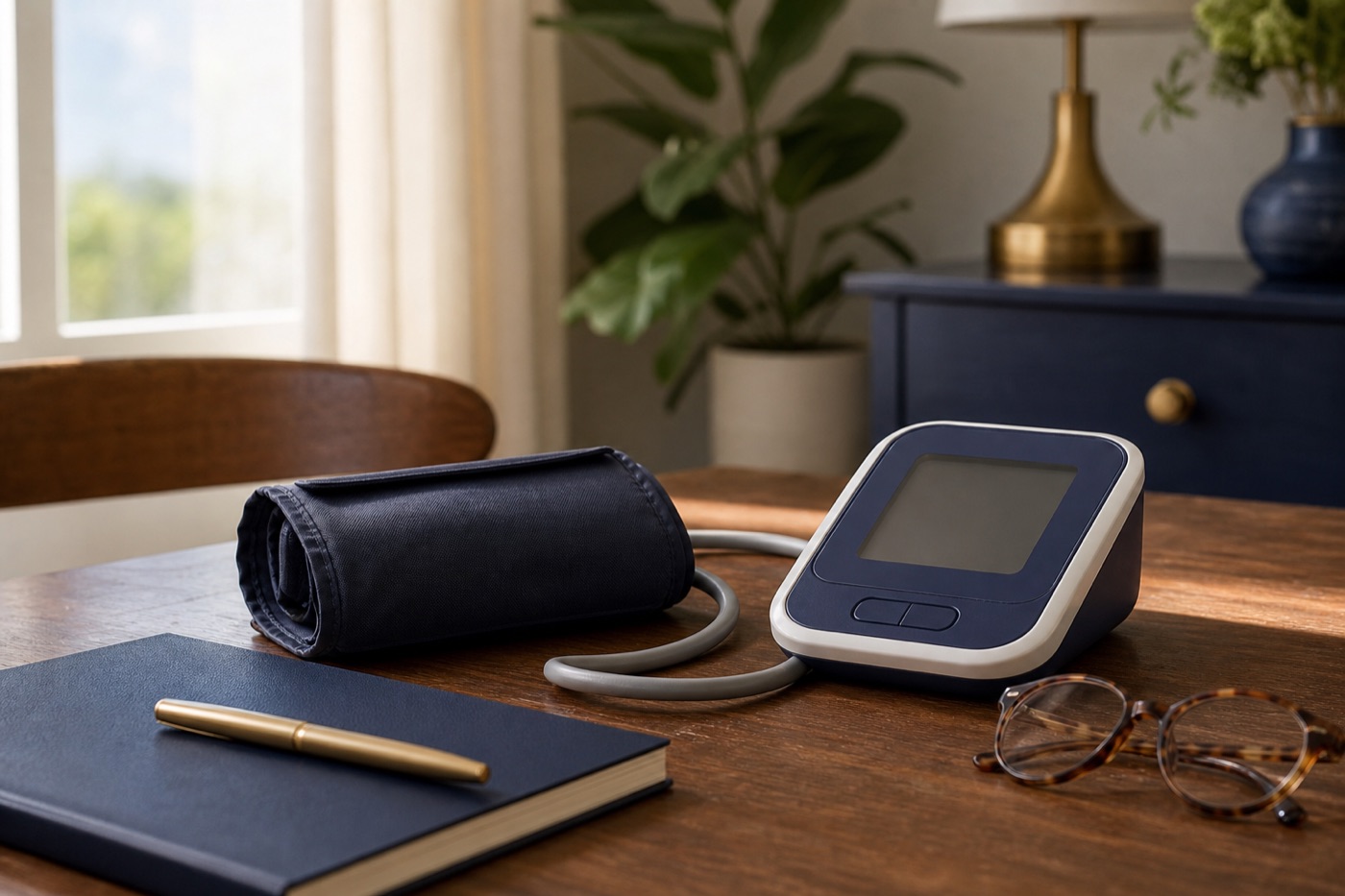
Our top blood pressure pick for 2027 is still a cuff: the Omron 10 Series (BP7465). The year brought watches, bands and rings that estimate blood pressure without squeezing your arm, but nearly all of them are sold as wellness tools, and each works best alongside a cuff, whether for calibration or for confirming what it flags. The Apple Watch Series 12 and Hilo Core are the finalists, each with clear limits explained below.
What changed in 2026
On January 6, 2026, the FDA replaced its 2019 general wellness guidance. The new version says the agency may treat non-invasive products that estimate values such as blood pressure as general wellness products, provided they are meant only for wellness, make no disease claims, are not meant to substitute for an FDA-authorized device, and do not show clinical-looking values unless those values are validated. Products intended for screening, diagnosis or monitoring of a condition still count as medical devices.
The market moved fast. Samsung opened blood pressure estimates on its watches to US Galaxy users on March 31, telling Android Authority that, as a wellness feature, it falls outside FDA clearance. Oura introduced Blood Pressure Signals in May. In June, according to MedTech Dive, the FDA said it would not enforce device requirements on a modified version of Whoop’s Blood Pressure Insights, closing a 2025 warning letter without clearing the feature. And in July, Hilo brought its Core band to the US. For buyers, the result is more blood pressure numbers than ever, and less clarity about which ones carry medical weight.
The yardstick for 2027
With so many estimates on sale, published evidence and an exact reading of each product’s regulatory status counted for more than usual. Novelty was credited where it was real, such as overnight sampling, but never allowed to outweigh validation. Access looked at required subscriptions and phone lock-in, and privacy at whether health data stays under the user’s control. The five weights behind every score are on the criteria page.
Winner: Omron 10 Series Upper Arm Blood Pressure Monitor (BP7465)
The case for buying this cuff in 2027 is simple: it is the reference point the wearables here lean on. Samsung’s watch needs a fresh cuff calibration every four weeks, Hilo’s band is calibrated by its own cuff, and Oura invites you to enter cuff readings beside its signals. Starting with a validated upper-arm monitor means you have trustworthy numbers to check them against.
Omron’s model then goes further than a plain cuff. Each measurement doubles as a screen for possible atrial fibrillation, under a De Novo authorization the FDA granted in October 2024 that created a new category for oscillometric AFib notification. In a trial of 559 people at several US sites, Omron says, the screen reached 95 percent sensitivity and 98 percent specificity when checked against cardiologist-read ECGs. The FDA limits it to home screening for possible AFib in adults; it is not meant for managing AFib that has already been diagnosed.
For daily use, three-reading TruRead averaging and a two-user memory of 200 readings keep the log honest without a phone, and Bluetooth sync to Omron’s no-cost connect app for iOS or Android adds unlimited history, trend charts and a way to send results to family or your care team. Omron backs the monitor with a five-year warranty.
Who should buy something else: anyone with an implanted cardiac device such as a pacemaker, pregnant users and people under 22, all of whom fall outside the monitor’s intended use according to Omron, plus anyone whose upper arm is wider than its 17-inch cuff. If you want an EKG trace as well, Omron’s Complete pairs a cuff with a single-lead EKG, and the FDA cleared it in 2019.
Finalist: Apple Watch Series 12
Apple’s hypertension notifications remain the only watch feature here with an FDA clearance tied to blood pressure; as of late October 2026, Apple’s feature is the sole entry under the hypertension notification software product code in the FDA’s 510(k) database. It reads optical heart sensor data in the background and, after 30-day review periods, alerts you to patterns suggestive of hypertension. It shows no blood pressure values.
You do not need the newest watch to get it: Apple’s rollout covered Series 9 and later and Ultra 2 and later, so the Series 12 matters here mainly for its other health upgrades. The feature is cleared for adults 22 and up who have not been diagnosed, not for pregnancy, and not as a way to track treatment. The FDA’s labeling adds that the lack of an alert does not mean the lack of hypertension, so use it as a prompt to buy a cuff, not a reason to skip one.
Finalist: Hilo Core
Hilo Core, launched in the US on July 21, 2026, by the Aktiia-developed brand Hilo, is the most ambitious product in the category. A screenless wristband reads optical signals through the day and night, and Hilo says the system captures 30 to 35 readings daily, including overnight, calibrated by periodic measurements from an included connected arm cuff that Hilo describes as FDA-cleared. Hilo also says the underlying technology has been validated in eight clinical studies.
The regulatory picture needs a careful reading. The FDA cleared Aktiia’s G0 Blood Pressure Monitoring System through a 510(k) in July 2025, yet Hilo’s launch release states that Hilo Core “is not a medical device and has not been cleared” by the FDA, and that its data should not be used for clinical decisions. It also requires an annual subscription on top of the hardware, which hurt it on access. It made the finalist list because no other wearable here offers that density of readings with a cuff built into the system.
Commended: Withings BPM Vision
For a household buying its first connected cuff in 2027, the BPM Vision is the friendliest choice. Withings says it is FDA cleared, and its color screen walks you through correct technique before each reading, takes three measurements in a row, syncs over Wi-Fi and keeps separate histories for up to eight people. Cuffs fit arms up to 20 inches.
Commended: Oura Ring 5
Oura’s Blood Pressure Signals watch for shifts in overnight patterns that may indicate cardiovascular strain, and in October Oura began rolling out features it calls Nighttime BP and Cuff Inputs alongside its Health Radar expansion. Oura says Health Radar is for general wellness only and that the ring is not a medical device. It needs an Oura Membership. Consider it an early-warning layer for people who already wear the ring, with a cuff for the actual numbers.
How the 2027 options stack up
| Product | Output | Regulatory position (FDA record or maker) | Needs a cuff? | Ongoing cost model |
|---|---|---|---|---|
| Omron 10 Series | Cuff readings plus AFib screen | AFib feature De Novo, 2024 | It is the cuff | None stated; free app |
| Apple Watch Series 12 | Hypertension alerts only | 510(k) cleared, 2025 | To confirm alerts | Built into watchOS |
| Hilo Core | 30–35 wellness estimates a day | Not cleared, per Hilo; cuff cleared | Included for calibration | Annual subscription |
| Withings BPM Vision | Guided cuff readings | FDA cleared, per Withings | It is the cuff | None stated; Withings app |
| Oura Ring 5 | Overnight wellness signals | Not a medical device, per Oura | For actual readings | Oura Membership |
Matching the device to the goal
- Your doctor asked you to log readings: Omron 10 Series, or the Withings BPM Vision for a shared home.
- You have no diagnosis and already wear an Apple Watch: switch on hypertension notifications and keep a cuff nearby.
- You are curious how your blood pressure moves overnight: Hilo Core, with its subscription and wellness label in mind.
- You sleep in an Oura ring: Blood Pressure Signals add context at no extra hardware cost.
- You own a recent Galaxy watch and phone: Samsung’s calibrated estimates are worth a look, cuff in hand.
The bottom line for next year
Cuffless blood pressure is no longer a prototype, but in 2026 it mostly arrived as wellness information rather than as cleared measurement. Until that changes, the smartest 2027 setup is a validated cuff first and a wearable second, and Omron’s 10 Series is our choice for that anchor. If your watch also tracks sleep, our 2027 sleep tracker prize page covers the apnea features that often travel with these blood pressure tools.
2027 badges in this category
Winners and finalists may show their badge for free. It must link back to this page and not be altered. Badge rules.
10 Series Upper Arm Blood Pressure Monitor (BP7465)
Winner, Blood Pressure Monitors 2027
Embed code
<a href="https://innovationprizes.org/2027/best-blood-pressure-monitors/"><img src="https://innovationprizes.org/badges/2027-best-blood-pressure-monitors-winner.svg" alt="Innovation Prizes 2027 Winner: Blood Pressure Monitors" width="160" height="160"></a>
Apple Watch Series 12
Finalist, Blood Pressure Monitors 2027
Embed code
<a href="https://innovationprizes.org/2027/best-blood-pressure-monitors/"><img src="https://innovationprizes.org/badges/2027-best-blood-pressure-monitors-finalist.svg" alt="Innovation Prizes 2027 Finalist: Blood Pressure Monitors" width="160" height="160"></a>
Hilo Core
Finalist, Blood Pressure Monitors 2027
Embed code
<a href="https://innovationprizes.org/2027/best-blood-pressure-monitors/"><img src="https://innovationprizes.org/badges/2027-best-blood-pressure-monitors-finalist.svg" alt="Innovation Prizes 2027 Finalist: Blood Pressure Monitors" width="160" height="160"></a>
Questions people ask
Are cuffless blood pressure wearables FDA-approved?
Mostly not in the form you can buy. The FDA cleared Aktiia's G0 cuffless system in July 2025, yet Hilo says the Hilo Core it sells in the US is not a medical device, and Samsung, Oura and Whoop present their estimates as wellness features. The one watch feature on this page with an FDA clearance, Apple's, sends alerts rather than readings.
Do I still need a cuff if I buy a blood pressure wearable?
Yes. Samsung requires cuff calibration every 28 days, Hilo ships its system with an FDA-cleared arm cuff for calibration, and Oura lets you add cuff readings to its app. A validated upper-arm cuff is also what your clinician will want to see.
Can I use these readings to change my medication?
Not on your own. Hilo's own disclaimer says its data should not be used for clinical decisions, and the FDA's labeling for Apple's feature excludes monitoring treatment. Bring readings from a cuff to your doctor, and get urgent care for very high readings with symptoms such as chest pain or trouble speaking.
Sources
- U.S. FDA: General Wellness: Policy for Low Risk Devices (January 6, 2026)
- Hilo: US launch of Hilo Core (PR Newswire, July 2026)
- U.S. FDA: 510(k) database entry K250507, Hypertension Notification Feature
- MedTech Dive: FDA drops Whoop warning letter over blood pressure feature (June 2026)
- Oura: Health Radar and GLP-1 Insights expansion (October 2026)
Prize pages are written and reviewed by the Innovation Prizes editors from what each maker publishes, FDA records and published research. Nobody pays to enter or to win. About the prizes.